
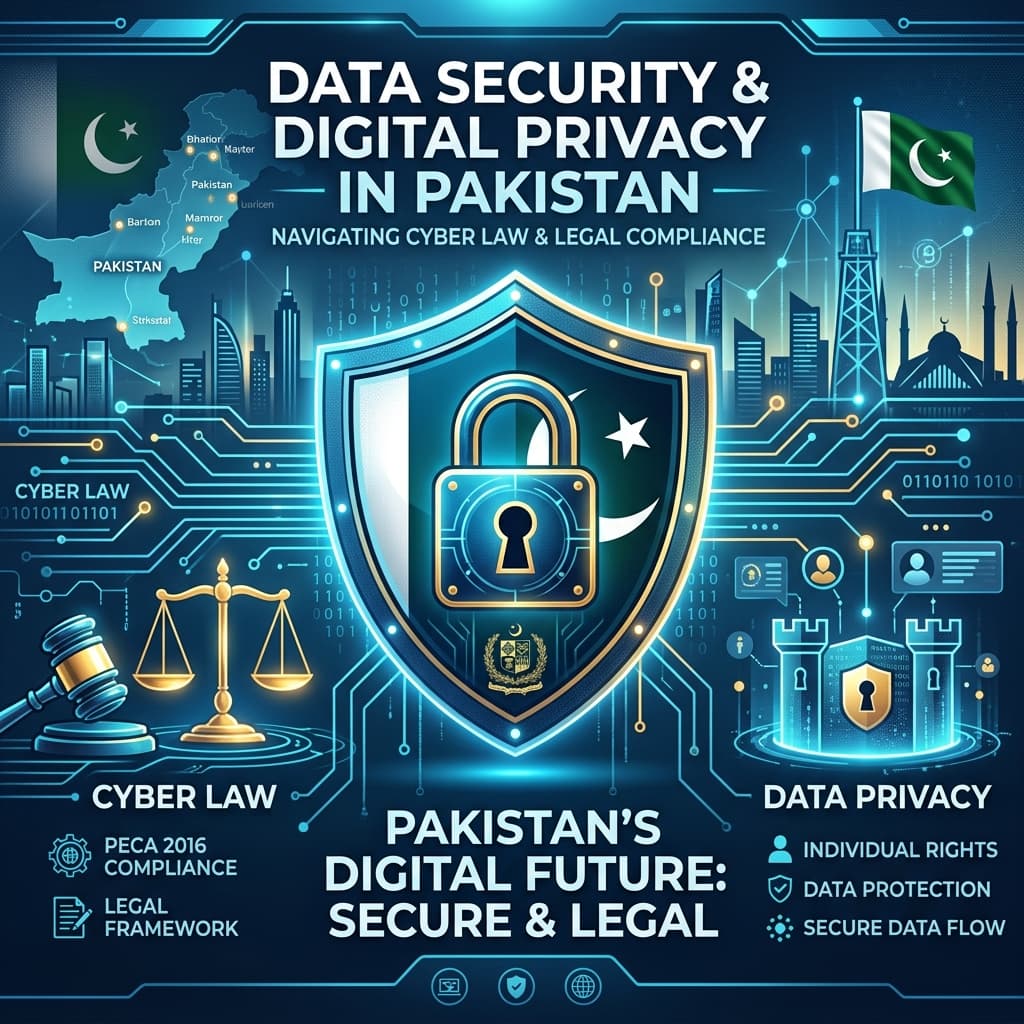
Data Security and Privacy Laws in Pakistan
What You Need to Know
Quick answer
A comprehensive guide to data protection, privacy laws, and cyber security regulations in Pakistan, including PECA and compliance requirements.
In an increasingly digital world, the protection of personal data and digital privacy has become a critical issue. Whether you are an individual wanting to protect your online identity, or a business handling customer data, understanding the data security and privacy laws in Pakistan is essential.
While Pakistan does not yet have a single, unified equivalent to Europe's GDPR, there are several laws, constitutional provisions, and sector-specific regulations that govern data privacy and cybersecurity.
1. The Constitutional Right to Privacy
The foundation of privacy in Pakistan is found in the Constitution. Article 14(1) of the Constitution of Pakistan guarantees the right to privacy, stating:
"The dignity of man and, subject to law, the privacy of home, shall be inviolable."
Courts in Pakistan have repeatedly interpreted this article to include digital privacy, communications, and personal data. This means that unauthorized surveillance, data breaches, and illegal access to personal information are inherently constitutional violations.
2. Prevention of Electronic Crimes Act (PECA), 2016
The most significant piece of legislation regarding digital security in Pakistan is the Prevention of Electronic Crimes Act (PECA), 2016. While primarily a cybercrime law, it contains crucial provisions relating to data protection.
Under PECA, the following acts are criminalized:
- Unauthorized Access (Section 3): Illegally accessing an information system or data.
- Unauthorized Copying or Transmission (Section 4): Stealing or transmitting data without permission.
- Interference with Information Systems (Section 5): Damaging, altering, or deleting data.
- Identity Theft (Section 16): Obtaining, selling, or using another person's identity information without authorization.
If your personal data is stolen or misused, or if a company suffers a data breach due to a cyberattack, PECA provides the legal framework for the FIA (Federal Investigation Agency) Cyber Crime Wing to investigate and prosecute the offenders.
3. Sector-Specific Data Regulations
Because a general data protection law is still pending, various regulatory bodies enforce their own data security standards on the organizations they oversee.
Banking and Finance (State Bank of Pakistan)
The State Bank of Pakistan (SBP) mandates strict cybersecurity and data protection guidelines for all banks and financial institutions. Banks are required to implement robust IT security frameworks, report data breaches immediately, and maintain strict confidentiality of customer financial data under the Banking Companies Ordinance, 1962.
Telecommunications (PTA)
The Pakistan Telecommunication Authority (PTA) regulates telecom operators and ISPs. Under the Telecom Reorganization Act, 1996 and various PTA regulations, operators are strictly forbidden from sharing customer call data records (CDRs) or personal information without a lawful warrant or court order.
Healthcare
While specific digital health data laws are still evolving, the ethical guidelines by the Pakistan Medical and Dental Council (PMDC) require doctors and hospitals to maintain strict patient confidentiality, which extends to electronic medical records (EMRs).
4. The Proposed Personal Data Protection Bill
Pakistan has been working on a dedicated Personal Data Protection Bill for several years. The draft bills (the most recent being discussed in 2023/2024) take heavy inspiration from the GDPR and aim to establish a comprehensive framework.
Key features of the proposed legislation include:
- Consent: Businesses must obtain explicit consent before collecting personal data.
- Purpose Limitation: Data can only be used for the specific purpose it was collected for.
- Data Subject Rights: Individuals will have the right to access, correct, or erase their data (the "Right to be Forgotten").
- Data Protection Authority: The establishment of a National Commission for Personal Data Protection (NCPDP) to enforce the law and issue fines.
- Data Localization: Requirements for "critical personal data" to be stored on servers located within Pakistan.
Note: As of this writing, this bill is still in the legislative process and has not yet become an active Act of Parliament. However, businesses are advised to start adopting its principles now to be compliant when it passes.
5. Best Practices for Businesses in Pakistan
If you run a business, an e-commerce store, or an app in Pakistan, you should not wait for the Data Protection Bill to pass. Failing to protect customer data can lead to massive reputational damage and action under PECA or consumer protection laws.
- Publish a Clear Privacy Policy: Clearly explain to your users what data you collect, why you collect it, and who you share it with.
- Secure Your Systems: Implement basic cybersecurity measures like SSL certificates, encrypted databases, and secure payment gateways.
- Collect Only What You Need: Do not hoard customer data. If you only need a phone number for delivery, don't ask for their CNIC.
- Train Your Staff: Most data breaches are caused by human error (e.g., falling for phishing emails). Train your employees on data security.
Conclusion
Data security in Pakistan is transitioning from a patchwork of telecom, banking, and cybercrime laws (PECA) toward a unified data protection regime. For individuals, knowing your rights under the Constitution and PECA is your first line of defense. For businesses, adopting international data privacy standards now is not just a legal precaution, but a competitive advantage in building trust with your customers.
Run your firm with clarity
Lawyer Diary brings matters, clients, billing, and hearings into one workspace built for Pakistani firms.
Create free account