
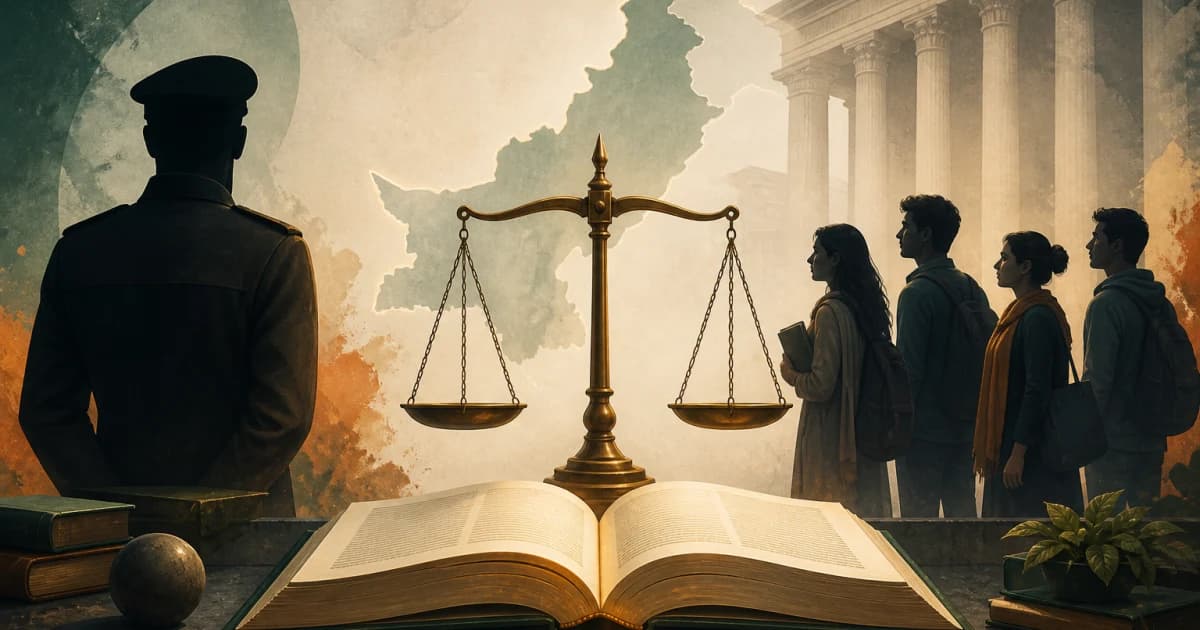
When the Uniform Becomes the Authority
What Does the Law Mean for Ordinary Pakistanis?
Quick answer
Omer Farooq examines the Sarhad University incident, police powers, constitutional rights, accountability, and what the rule of law means for ordinary Pakistanis.
Written by Omer Farooq
The recent incident at Sarhad University in Islamabad has raised a question that goes far beyond one university, one group of students, or one uniformed official:
In Pakistan, who is actually accountable when the people enforcing authority appear to stand above the law?
Videos circulating from Sarhad University of Science and Information Technology's Chattha Bakhtawar campus show a uniformed man confronting students, striking a student with what appears to be a stick, becoming involved in a physical confrontation, drawing a pistol and subsequently discharging it into the air. Police officers can then be seen approaching and escorting him away. According to reporting by Dawn on August 24, 2026, sources close to the investigation said the security official was taken into custody and could face disciplinary action under military law.
There are still unanswered questions about what happened before the video began, what triggered the confrontation, and exactly what legal authority the individual was exercising. Those questions must be established through an impartial investigation.
But the incident raises a much larger issue:
What happens when ordinary citizens encounter the state—or someone perceived to represent the state?
The First Question: Who Has Authority?
This is where the discussion should begin.
A person wearing a military uniform is not automatically transformed into a police officer.
A military officer may have powers under specific laws and circumstances, but wearing a uniform is not itself a source of unlimited authority over civilians.
The same principle applies to police officers.
A police officer has statutory powers. Those powers come from the Constitution, legislation and applicable rules. They are not simply personal powers belonging to the individual wearing the uniform.
This distinction matters enormously.
Because if the principle becomes:
“I am wearing a uniform, therefore you must obey whatever I say,”
then the uniform itself becomes the law.
And that is fundamentally different from the rule of law.
What Does Pakistani Law Actually Say?
Pakistan's Constitution establishes important protections for individuals.
The Constitution of the Islamic Republic of Pakistan provides the right to be treated in accordance with law under Article 4. Article 9 protects life and liberty except in accordance with law. Article 10 provides safeguards concerning arrest and detention, while Article 10A guarantees fair trial and due process.
These provisions are not theoretical decorations.
They exist precisely because the relationship between an individual and the state is unequal.
The state has police.
The state has prisons.
The state has weapons.
The state has investigative institutions.
The ordinary citizen generally has none of these things.
That is why the law places restrictions on the exercise of state power.
“But Police Can Arrest Without a Warrant”
This is where many discussions about police powers become confused.
Yes, Pakistani law does allow police to make certain arrests without obtaining a warrant first.
Section 54 of the Code of Criminal Procedure, 1898 provides circumstances in which police may arrest without a warrant. But the existence of a warrantless-arrest power does not mean that police can arrest anybody, at any time, for any reason.
There are legal conditions attached to the power.
And once somebody is arrested, further safeguards apply.
Sections 60 and 61 of the CrPC deal with taking an arrested person before the appropriate authority and restricting detention without a Magistrate's special order beyond the prescribed period.
No warrant does not mean no law.
It means the law itself provides certain circumstances in which a warrant is unnecessary.
That is a very different proposition.
Stopping Someone Is Not the Same as Arresting Them
This distinction is also important when discussing students.
There is a significant legal difference between:
“Stop for a moment and show me your identification.”
and
“You are being detained and you cannot leave.”
There is another difference between that and:
“You are under arrest.”
And there is another question entirely when an officer searches someone's bag, vehicle or mobile phone.
Every escalation in state power requires a corresponding legal basis.
The fact that a person is a student does not remove their constitutional rights.
And the fact that the other person is a police officer does not remove the officer's legal obligations.
The Sarhad University Question
This brings us back to what happened at Sarhad University.
According to Dawn, students had been protesting over university-related issues when the confrontation occurred. The video shows the uniformed individual approaching the students, a physical confrontation developing, and the individual subsequently drawing and discharging a firearm into the air.
There are competing accounts about what happened before the footage.
Some reports say the official came to the university after a woman associated with the university was allegedly harassed by students. Other accounts primarily present the students' version of the confrontation. These claims require proper investigation rather than assumption.
But even if the students were behaving unlawfully, another question remains:
What was the lawful response?
If students assaulted someone, they can potentially be held accountable.
If students threatened someone, that can potentially have legal consequences.
If students committed an offence, the proper authorities can investigate and prosecute them.
But the existence of possible misconduct by students does not automatically give another person unlimited authority to use force.
The Firearm Changes the Question Completely
Once a firearm is introduced, this stops being merely a disagreement between students and university administration.
It becomes a question of use of force and public safety.
A firearm is not simply another means of settling an argument.
The central questions for investigators should therefore include:
- Who initiated the physical confrontation?
- What threat was the official facing at the moment the firearm was drawn?
- Was there an immediate threat to life or serious bodily harm?
- Was firing the weapon necessary?
- Where was the weapon pointed?
- How many shots were discharged?
- Who was potentially placed in danger?
- Was the official acting under any official authority?
- Why was an armed security official involved in a civilian university dispute in the first place?
The available video cannot answer all of these questions.
That is precisely why an investigation matters.
And What About the Police?
This may be the most uncomfortable part.
Videos appear to show police arriving during the incident and subsequently escorting the uniformed individual away. Dawn reported that a senior Islamabad police official later told students that the individual would face strict and swift action under military disciplinary procedures.
But citizens are entitled to ask:
What exactly was the police response?
If an ordinary civilian pulled out a firearm during a confrontation at a university, people would reasonably expect the police to investigate immediately.
So the question should not be:
“What institution did he belong to?”
The question should be:
“What does the law require when anyone—civilian, police officer or military officer—uses a firearm in a confrontation involving civilians?”
That is the standard a functioning rule-of-law system should aspire to.
The Real Problem: Two Different Standards
This is where the Sarhad University incident becomes bigger than Sarhad University.
Pakistan does not necessarily suffer from a complete absence of laws.
The Constitution contains fundamental rights.
The CrPC contains arrest and detention procedures.
Courts exist.
Police institutions exist.
Military disciplinary mechanisms exist.
The deeper problem can be unequal application of those rules.
An ordinary citizen may think twice before challenging an officer.
A student may be afraid to question a police officer.
A family may hesitate to file a complaint.
A witness may fear retaliation.
And once people begin believing that the person in uniform receives one standard while the civilian receives another, public confidence in the law begins to disappear.
A Uniform Should Not Become a Shield
There is an important principle that should apply to everyone:
Authority comes from law—not merely from a uniform.
A police uniform represents legal authority.
A military uniform represents military service.
Neither should become a personal shield against accountability.
And this principle should apply equally in both directions.
If a student assaults an officer, investigate it.
If a student damages university property, investigate it.
If a student threatens someone, investigate it.
But if an officer assaults a student, that should also be investigated.
If an officer unlawfully threatens civilians, that should be investigated.
If an officer unlawfully uses a firearm, that should be investigated.
The identity of the person should not determine the standard of justice.
Students Have Rights—But They Also Have Responsibilities
This discussion should not become an argument that students are automatically innocent.
They are citizens, and citizens have responsibilities.
A protest does not give anyone the right to assault another person.
Freedom of expression does not mean freedom to commit violence.
A disagreement with university management does not justify attacking staff.
The rule of law must work both ways.
But that is exactly why it must work both ways.
If the principle is:
“You must obey the law because I have authority,”
then the person exercising that authority must be held to the law as well.
The Bigger Question for Pakistan
The Sarhad University incident should therefore not simply become another viral video that disappears after a few days.
It should lead to a more fundamental discussion:
What does the rule of law actually mean for an ordinary Pakistani?
Does it mean that citizens have rights only when confronting other citizens?
Does it mean that constitutional protections become weaker when the person standing in front of you is wearing a uniform?
Or does it mean that every exercise of state power must ultimately be capable of being justified by law?
The answer should be obvious.
Justice Cannot Have Two Doors
Pakistan does not need a system where one set of rules applies to students and another to people with institutional power.
It needs a system where the same fundamental principle applies to everyone:
- If you have done nothing wrong, the law should protect you.
- If you have committed an offence, the law should hold you accountable.
- If you are given extraordinary powers because of your position, then the responsibility to exercise those powers lawfully should be greater—not smaller.
The Sarhad University incident is therefore not merely about a confrontation between a uniformed security official and students.
It is about something much bigger:
Whether the uniform represents the law—or whether, in the eyes of ordinary citizens, the uniform has become bigger than the law.
And that is a question Pakistan cannot afford to ignore.
Editorial note: This article is commentary based on publicly available reporting as of August 25, 2026. Allegations concerning the incident remain subject to investigation. The article provides general legal information and does not constitute legal advice.
Run your firm with clarity
Lawyer Diary brings matters, clients, billing, and hearings into one workspace built for Pakistani firms.
Create free account